

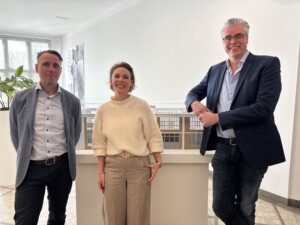
 Enabling scale: GEA and NIZO build the Biotechnology Fermentation Factory
A new open-access facility in Ede helps turn promising fermentation innovations into real-world applications, bringing sustainable food solutions closer to market.
Bringing innovations to market, and ultimately into products that are affordable, scalable and accepted by consumers, is far from straightforward. Many promising ideas never make it beyond the lab, getting stuck in the transition to large-scale production. This challenge lies at the heart of the collaboration between NIZO and GEA on the Biotechnology Fermentation Factory (BFF) at the NIZO campus in Ede, the Netherlands. It is no coincidence that BFF also stands for “best friends forever” a subtle nod to the close collaboration and shared commitment between current and future partners involved.
The BFF is being developed as an open-access scale-up facility where companies can validate their products and processes at pilot scale. It tackles a well-known challenge in food innovation: scale-up from the lab to commercial production at industrial scale. Many technologies perform well under controlled lab conditions. The BFF then helps bridge the gap to demonstrate scale-up and make it more predictable and accessible. The BFF’s pilot capabilities are made possible through the Dutch National Growth Fund programme Cellular Agriculture Netherlands (CAN), together with regional co-funding from OostNL and in-kind contributions from NIZO. Together, these investments strengthen the Netherlands’ position as a leading hub for fermentation-based food innovation and supports companies in bringing innovations to market faster.
“The entire concept is focused on de-risking, not only for companies, but also for investors. At this stage, it is crucial to demonstrate that a process is scalable, cost-effective and suitable for food-grade applications.”
— Robyn Eijlander, NIZO
Scaling with flexibility
The BFF focuses on higher Technology Readiness Levels (TRL), roughly between TRL 4 and 7, the stage where ideas need to prove they can work outside the lab. Here, companies can test, optimise and validate their processes, making them ready for commercialisation. The facility supports both precision fermentation and biomass fermentation, enabling applications ranging from novel proteins to functional ingredients. At the same time, fermentation and biotechnology are moving rapidly up the agenda, not just within companies, but also at a national and European level. In the Netherlands, this is reflected in the vision on future prosperity led by Peter Wennink, which identifies bio- and process technology for new ingredients as a key growth area. Next Food Collective plays an active role in shaping this development, particularly through programmes focused on future proof ingredients and fermentation-based solutions. This reinforces the broader shift towards scalable, sustainable production methods, an area where facilities like the BFF can play a supporting role. Flexibility is a key design principle. Rather than being optimised for a single product, the BFF is built to handle a wide range of microorganisms and processes, making it suitable for diverse applications and future developments.
As Gerben Kiers from GEA explains, this shift is not just technical, but also something he recognises in everyday life:
“What makes this development so interesting is that we’re moving towards a new way of fermentation. Instead of producing an end product, we’re producing functional ingredients that can be applied in many different food applications. That fundamentally changes how we think about food production.”
Having worked with food technology for years, from dairy processing to brewing beer at home, Gerben has seen how traditional processes and products are evolving. Even in his own kitchen, he notices how food is changing: familiar products like filet americain are increasingly blended with plant-based ingredients, often without consumers realising it.
More than an installation
NIZO selected GEA as a turnkey partner to deliver the full process line. But for both organisations, the BFF is more than just a technical installation, it represents a long-term collaboration around innovation in food.
“What makes me proud is that we’re not just talking about sustainability and new food, we’re actually making it happen. With projects like the BFF, we’re taking concrete steps to help our customers and the industry move forward.”
— Joost Barneveld, GEA
For GEA, the BFF fits closely with its strategic focus on sustainability and new food solutions. The technologies behind precision fermentation have their roots in the pharmaceutical industry, but are now finding their way into food — opening up new possibilities for ingredients and production methods.
At the same time, the BFF offers a practical environment to keep developing and improving those technologies. It allows GEA to test new equipment, explore innovations and support customers in taking the next step towards scale.
Addressing the ‘missing middle’
One of the key challenges in food innovation lies in what is often called the “missing middle”. Many startups and scale-ups develop promising technologies, but struggle to move beyond the lab because they lack the facilities, resources or experience to scale.
At the same time, larger companies are actively looking for new solutions, but often find it difficult to bridge the gap between early-stage innovation and industrial application.
The BFF is designed to operate exactly in this space, where ideas need to prove they can work in practice.
The facility is open to a wide range of users, from startups and corporates to technology developers and SMEs. It also provides opportunities to test enabling technologies, such as sensors and process control solutions, in a realistic production environment.
International ambition
Although the BFF is being developed in the Netherlands, its ambition is clearly international. Similar initiatives exist, for example in Ghent, and collaboration between such facilities is essential to strengthen Europe’s position in biotechnology and food innovation.
“We are already seeing interest from the United States. Companies are looking at the BFF as the next step after smaller pilot facilities.”
— Gerben Kiers, GEA
Collaboration as a foundation
The BFF is built on collaboration rather than operating as a stand-alone facility. Bringing together companies, investors, knowledge institutions, public stakeholders and technology providers around a shared ambition: accelerating innovation in food. This approach closely aligns with the ambitions and philosophy of Next Food Collective. The BFF provides a tangible example of how such collaboration can take shape: as a shared facility where science, technology and industry come together.
Reflecting on the broader impact, Robyn Eijlander adds: “What I find most rewarding is contributing to real progress in the food system. There are so many promising ideas, but scaling remains a major bottleneck. If we can help bring those innovations closer to real-world application, that’s something to be truly proud of.”
Looking ahead
The BFF is expected to become fully operational in 2027, with smaller volumes already available today. The coming year will focus on completing the facility to allow for scaling to 10,000L and building a strong network of users and partners.
The BFF will be truly successful when its schedule is filled with companies working to bring new solutions closer to real-world application.